My use of cannabis is much more than recreational — in fact, these days it is simply part of my everyday working life. For one thing, it soothes my stomach, which is increasingly uncomfortable whenever I eat or sit at the computer. For another, it opens my mind to new thoughts, which I believe were perhaps always there, but to which I might not pay any attention if I weren’t stoned.
They say you can’t multitask, but my mind often runs on several channels at once, sometimes alternating rapidly between one and the other. Consuming cannabis helps me to focus, which is often difficult to do when I’m just listening to someone else speaking. Whatever they’re saying is rarely capable of holding my full attention, evening though it might be useful or interesting.
And somehow I enjoy the mental effort of functioning at full capacity when I’m a little stoned (and that’s all I ever am). I do not suggest that others emulate my practice — not even Victoria does, though she does partake in the evening. We no longer smoke but use a simple handheld vaporizer that frees the volatiles that we inhale without smoke, leaving behind a rich powder with which I make brownies and eat one for breakfast with my coffee every morning.
A thoroughly debauched life, at one level, but one that fulfills my deepest aspirations — to be working on that which makes a difference and nothing more. What would the world be like if no one was willing to do anything that their heart and their head found unacceptable?
Getting on with this is becoming more urgent in view of my apparently deteriorating health. Recent tests are showing extremely elevated levels of pancreatic enzymes along with symptoms of liver disease. My liver has always been my weakest point, since contracting hepatitis at the age of 12 while at a boarding school in Mexico City. This would have been in 1956, an era that now seems almost prehistorical, an era when Catholicism still appeared plausible (at least to a 12-year-old surrounded by believing adults). Moreover, while I was sick I had a powerful vision of walking alongside Jesus riding a donkey, discussing the truly revolutionary nature of his message. For several years thereafter I had a personal relationship with God, though not always a happy one, and in the end, my mother’s staunch atheism carried the day. Or at least God became a different kind of question for me, one much less urgent in the face of what was clearly happening in the world. But I share with others of my generation the delusions of religiosity at an early age and a recognition that for many if not all of us there is a spiritual side of life that remains open-ended as far as one can tell.
This does not have much to do with cannabis, except that I’m consuming more of it in an effort to settle my stomach, and without it I likely would not be writing at all.
Time dilation
There is no time, i.e., no such thing as time.
There is no thing in the universe that is timeless, i.e., no thing that exists outside of time. There is no thing in the universe that is not in motion. Time is a dimension of things in motion.
From Einstein, we know that space and time are related, and that time occurs differently for things moving at different speeds relative to each other. But on Earth we’re all moving in space relative to other things at about the same speed, so time, as measured, is pretty much constant.
But with cannabis, time is dilated, and subjectively expanded: more experience happens within the same moment. This also seems to occur when traveling; because everything is different from what we’re used to, it seems as if more is occurring within a given amount of time, and therefore the experience seems richer, more intense. Cannabis has some of this effect: it reveals more of reality, and therefore feels more intense.
I’m not sure what any of this means. It’s just what occurred to me in the middle of the night of February 28, 2023 (actually the early morning of March 1).
These asides can probably go anywhere, but they’re part of the story. The only reason to consult the past, in my opinion, is to inform the present. History is never just about the past; it’s also about its relevance to the present.
I do have a sense of time being short, especially when I experience a “minor health crisis,” as is happening recently with my pancreas. Ironic if it is this humble organ that finally does me in, but ultimately it does not matter. Ultimately it’s the weakest link in the chain that gives way, and just like that a life is snuffed out. What does it matter really? Every life must come to an end, and if it’s been as fulfilling as mine has been one has no reason to complain. The question is, what to do with all the loose ends?
Here are just a few: these ramblings to begin with. Then there’s the question of the overall literary accomplishment — mainly a series of promising false starts. Right now they add up to very little. Certainly not a coherent body of work. I suspect that’s the way most people’s lives are; it’s a wonder that meaningful things are completed at all.
Very few of us will be remembered, and even then only by a few. There are simply way too many of us for anyone to expect to be remembered. And frankly, only a few of us even deserve to be remembered. The vast majority of humans are quite forgettable, and deservedly so, having done more harm than good during their lives, or simply having done nothing of any significance whatsoever. Why should we remember the millions who came before us, who built the flawed world we have inherited, teetering on the brink of disaster?
Those who might be worth remembering are those who brought us through to the other side, to a better world, a world of better humans, more conscious of their place in Nature, more responsible for preserving what little there is of value in human history. Certainly not the majority of those considered important to the course of history, the monsters who brought disaster upon themselves and others and on the natural world, the Hitlers and Stalins, the Trumps and the Putins, who dominate the stories only because of the destruction they were capable of. Then there are the millions of soldiers, of workers, of peasants who gave their lives in service of the greedy plutocrats that, it seems, eventually gain power in the dying days of civilizations. Why should we mourn for them? It certainly does them no good. Better we should focus on those who sought to live lives of purpose, of meaning, of service to others, including of service to other creatures.
In our time, surely it is those who recognize the truth and seek to make it known to others, who work to diminish the harm and to build new realities that we are worthy of.
I doubt I’d be seeing much of this if it weren’t for cannabis.
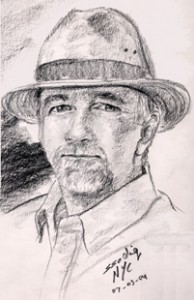 Whenever I’m confused, I turn not only to cannabis but also return to these stories, to remind myself of who I am. The fact that I prefer this sketch to many of the photos I and others have taken of me over the years perhaps betrays some sense of unworthiness. It’s taken me a long time to learn to love myself, and I think that’s true of many others also. Why we have these difficulties is still something of a mystery to me.
Why aren’t we more like flowering plants, each standing alone in a meadow of profusion, reaching for the sky and the warmth of the sunlight, unafraid to show our true colors?
That these thoughts and questions occur to me during a workday also suggests some degree of self-doubt. Am I fulfilling my true potential? What is that potential, anyway? Do I have a choice about it? What if I make the wrong choice, and spend too much of my life on things like bookkeeping rather than the really important issues? Idle speculation. The bookkeeping, unfortunately, is unavoidable.
Sometimes I smoke right before going to bed, though actually I no longer smoke at all, but rather vape, inhaling the volatile compounds released by heating the ground-up flower to 428° (or so the device says) . This evening I sat in a chair, puffing, as Sherlock Holmes was said to have done not only with tobacco but also with opium in trying to solve the mysteries in Sir Arthur Conan Doyle’s stories. (Not sure why we still use the honorific, since we Americans believe we abolished the very idea of titular “nobility.”) Except in this case the mystery is the fate of the world. It sounds melodramatic, but unfortunately, it is all too real.
Whether any of this will survive is questionable, given that it’s not even written or printed on paper but is posted in an entirely imaginary world we call “the digital world.” But will we really be able to keep the Internet going when all else is collapsing around us? For we expect global supply chains to collapse, as massive heat waves decimate whole populations, shrivel crops, and burn the forests. Perhaps some crazed survivalists will hold on, below ground let’s say, where the temperature is always cooler (or is it — once upon a time it was certainly hotter). It’s unclear what a hostile runaway environment might look like. Will it run out of oxygen? Or create so much oxygen that things just spontaneously combust?
In any case, what we’re facing is clearly a “polycrisis,” which is what we’re now calling it. The convergence of loss of biodiversity through mass extinction with the boiling-frog version of global warming. But we just won’t notice it until it’s too late. When we do see it — like the insect apocalypse — it comes as a shock that we had not seen it until it was drawn to our attention. We say, then we realized it, not in the sense of making it real but of recognizing its unavoidable reality in the physical world. (We say “the real world,” but in what sense is the virtual world any less real once we’ve created it?). And this is not even the half of it. We’re running out of freshwater and of other key resources, as well as of space for our toxic wastes. And we continue to destroy the natural habitat of other species than our own. If in the end we somehow pull through it, it will need to be a restored Earth, or else it will not persist at all.